Machine Learning Fundamental Elements

Understanding Hypothesis Space, Inductive Bias, Evaluation & Cross-Validation

Dr. Dhaval Patel • 2025

What is Machine Learning Really About?

Think of machine learning like teaching a child to recognize different animals. Just as a child learns to distinguish between cats and dogs by seeing many examples, machine learning algorithms learn patterns from data to make predictions about new, unseen information.

Child learning to recognize different animals from picture books
  • Computers learn from examples, just like humans do
  • The goal is to find patterns that work on new, unseen data
  • Success depends on making smart assumptions about the problem
  • We must carefully test our models to ensure they truly understand
The key challenge: How do we ensure our "digital student" truly understands the underlying patterns rather than just memorizing specific examples?

Hypothesis Space

The set of Possible Solutions

What is Hypothesis Space?

Imagine you're looking for a house in a city. The hypothesis space is like all the possible houses that exist in that city - every single building that could potentially be your new home.

City map showing all possible houses representing hypothesis space
  • Hypothesis Space (H): All possible models or functions our algorithm can consider
  • Each Hypothesis (h): One specific way of mapping inputs to outputs
  • The Goal: Find the best hypothesis that fits our data and generalizes well
Think of it as your algorithm's "shopping catalog" of possible solutions!

Real-World Examples of Hypothesis Spaces

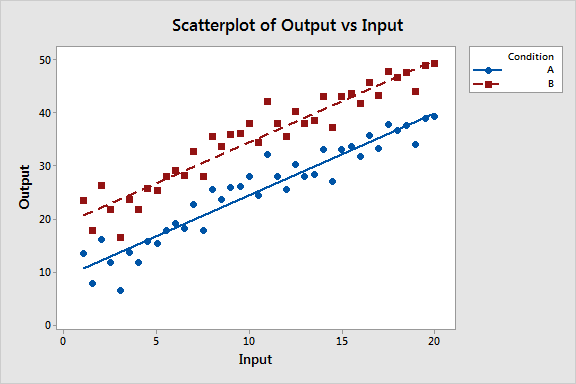
Linear Regression

Graph showing multiple possible linear regression lines through data points

Hypothesis Space: All possible straight lines (y = mx + b)

Each Hypothesis: One specific line with particular slope and intercept

Goal: Find the line that best fits our data points
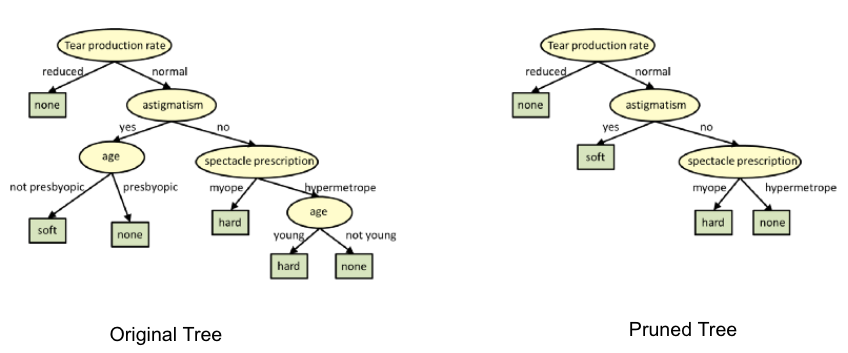
Decision Trees

Multiple decision tree structures showing different ways to split data

Hypothesis Space: All possible decision trees we can build

Each Hypothesis: One specific tree structure with particular splits

Goal: Find the tree that makes the most accurate predictions

The Challenge

2^(2^10) = 2^1024 possible functions

For just 10 yes/no features!


That's more than the number of atoms
in the observable universe!

Note: Playing piano without any guidance.

Inductive Bias

The Guiding Principles

What is Inductive Bias?

Inductive bias is like having a wise mentor who gives you helpful assumptions and guidelines to narrow down your search.
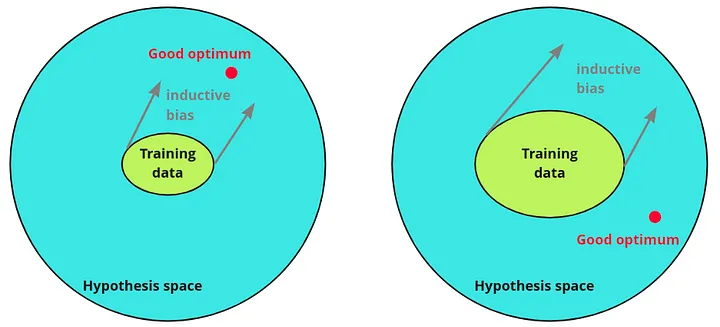
Wise mentor guiding a student through choices

Think of it as:

  • The preferences our algorithm has before seeing any data
  • The assumptions built into our model's architecture
  • The constraints that help us avoid getting lost in the vast hypothesis space
Without inductive bias, learning from limited data would be impossible! An infinite number of hypotheses could perfectly fit any finite dataset.

Two Types of Inductive Bias

Restrictive Bias

Architectural Constraints

Like choosing to only look for houses in certain neighborhoods.

Example: Linear regression can ONLY learn straight-line relationships. It cannot discover curved patterns no matter how much data it sees.
  • ✅ Can learn: Price increases linearly with size
  • ❌ Cannot learn: Complex curved relationships

Preference Bias

Selection Criteria

Like preferring simpler, more elegant solutions.

Example: Let's say you see the following sequence: 2, 4, 6, 8

You could come up with a few rules:

  • "Add 2 to the previous number." This is a very simple and straightforward rule.
  • "If the number is even and positive, it's part of the sequence." This is also true but a bit more complicated than just adding 2.
  • "Multiply the position by 2." (e.g., 1st number * 2 = 2, 2nd number * 2 = 4) This is also simple and similar to the first rule.
  • Favors interpretable models
  • Reduces overfitting risk
  • Easier to understand and explain
VS

Inductive Biases in Popular Algorithms

Each machine learning algorithm has its own "personality" - its built-in assumptions about how the world works:

  • k-Nearest Neighbors: "Birds of a feather flock together" - similar things are near each other
  • Support Vector Machines: "The safest path between two cliffs is right down the middle" - maximum margin separation
  • Neural Networks: "Complex behaviors emerge from simple parts working together" - hierarchical feature learning
  • Naive Bayes: "Features are independent given the class" - conditional independence assumption
The "No Free Lunch" Theorem: No algorithm works best for all problems. Success comes from matching the right bias to your specific problem!

How Hypothesis Space and Inductive Bias Work Together

Large library with librarian helping someone find specific books
Perfect Analogy: Think of hypothesis space as a vast library containing all possible books (solutions), and inductive bias as a knowledgeable librarian who knows exactly which sections to guide you to. The librarian (bias) doesn't change what books exist (hypothesis space), but makes finding the right book (solution) actually possible!

Finding the Sweet Spot: The Goldilocks Principle

Three bears representing underfitting, overfitting, and just right models

The Three Scenarios

Too Restrictive (Underfitting): Like only reading children's picture books when you need advanced mathematics. Model too simple to capture important patterns.

Too Flexible (Overfitting): Like memorizing every page without understanding. Model learns noise instead of true patterns.

Just Right: Finding the perfect balance where your model captures true patterns and generalizes well to new data!

Model Evaluation

How Do We Know If We're Doing Well?

Why Model Evaluation is Critical

Imagine you're a teacher grading students. You wouldn't just look at homework performance; you'd give them tests on new problems to see if they truly understand the material.

Teacher giving test to students to evaluate understanding

Similarly, we need to test our ML models on new, unseen data to measure their real-world performance.

  • Prevents us from being fooled by "memorization" instead of true learning
  • Identifies bias and fairness issues before deployment
  • Helps us choose between different algorithms and approaches
  • Provides confidence that our model will work in practice
Without proper evaluation, a model might seem brilliant in training but fail catastrophically in the real world!

Classification Metrics: The Confusion Matrix Foundation

2x2 confusion matrix with clear labels and examples

The foundation for understanding all classification metrics
Think of it as a detailed report card: The confusion matrix shows exactly where your model succeeded and failed. It's the foundation for calculating accuracy, precision, recall, and F1-score. Every classification metric starts here!

Essential Metrics from the Confusion Matrix

These four equations form the foundation of classification evaluation, all derived from the confusion matrix components:

Accuracy

Accuracy = TP + TNTP + TN + FP + FN

Overall correctness: What proportion of all predictions were correct?

Precision

Precision = TPTP + FP

Quality of positive predictions: Of all positive predictions, how many were actually correct?

Recall (Sensitivity)

Recall = TPTP + FN

Coverage of actual positives: Of all actual positive cases, how many did we identify?

F1-Score

F1 = 2 × Precision × RecallPrecision + Recall

Harmonic mean: Balanced measure combining both precision and recall into a single score.

Remember: TP = True Positives, TN = True Negatives, FP = False Positives, FN = False Negatives

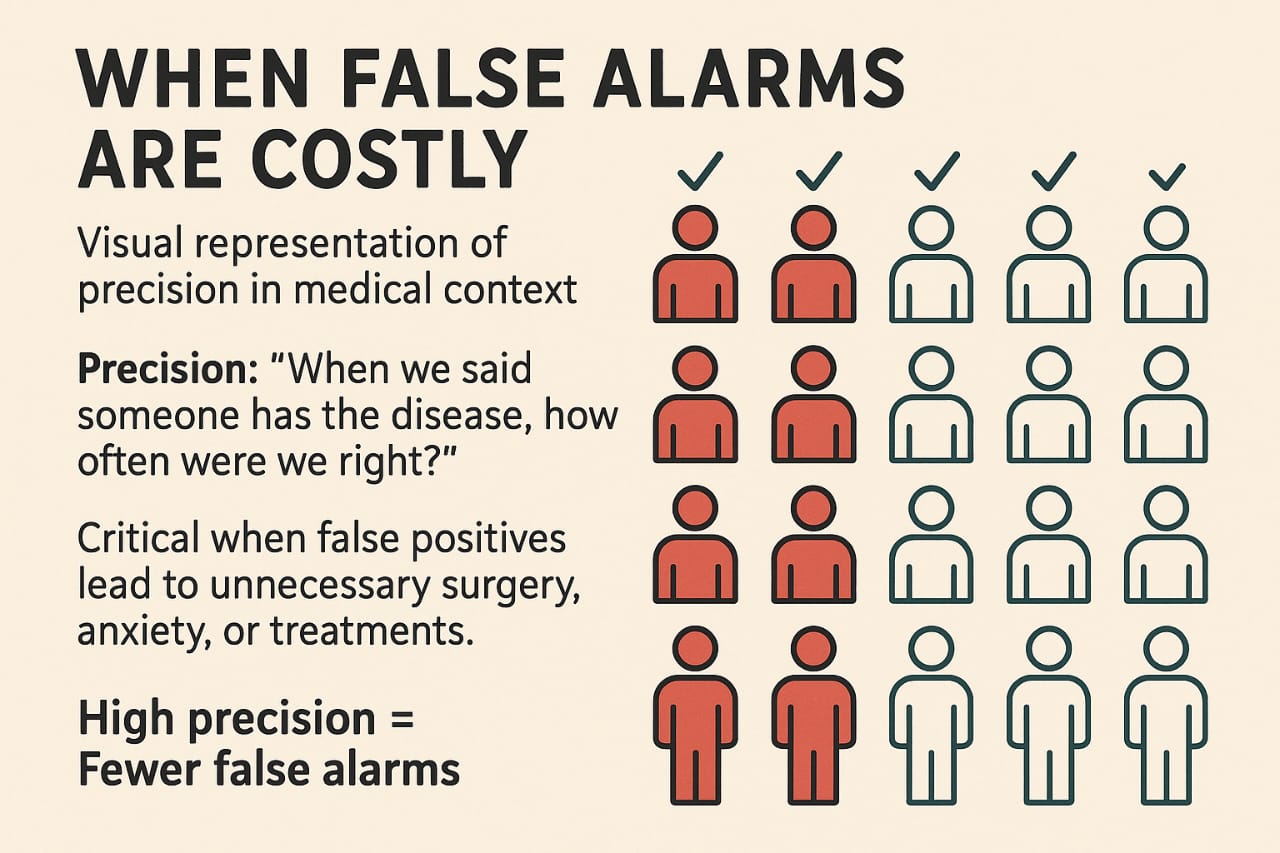
Understanding Metrics with Medical Diagnosis

When False Alarms are Costly

Visual representation of precision in medical context

Precision: "When we said someone has the disease, how often were we right?"

Critical when false positives lead to unnecessary surgery, anxiety, or treatments.
High precision = Fewer false alarms

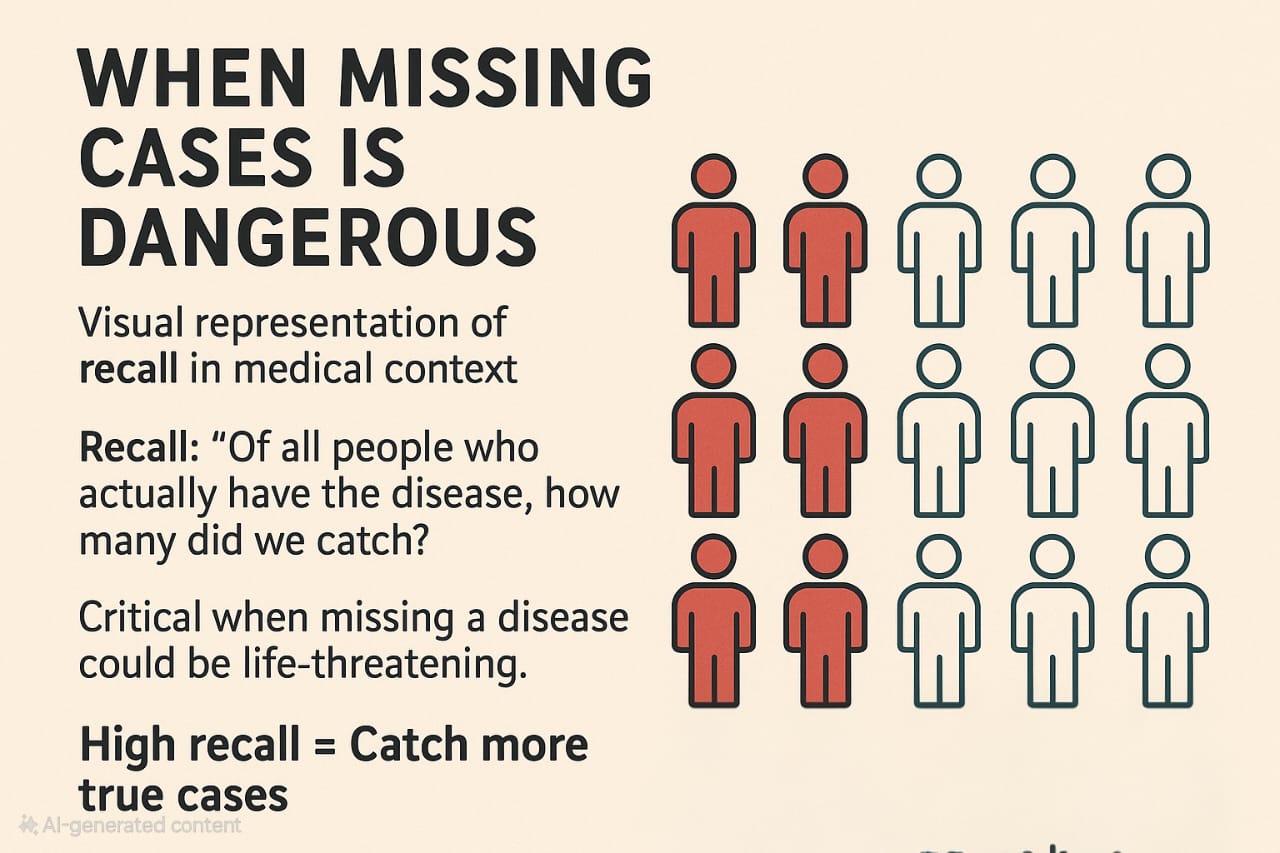
When Missing Cases is Dangerous

Visual representation of recall in medical context

Recall: "Of all people who actually have the disease, how many did we catch?"

Critical when missing a disease could be life-threatening.

High recall = Catch more true cases

Regression Metrics: Measuring Continuous Predictions

When predicting continuous values like house prices or temperatures, we need different metrics:
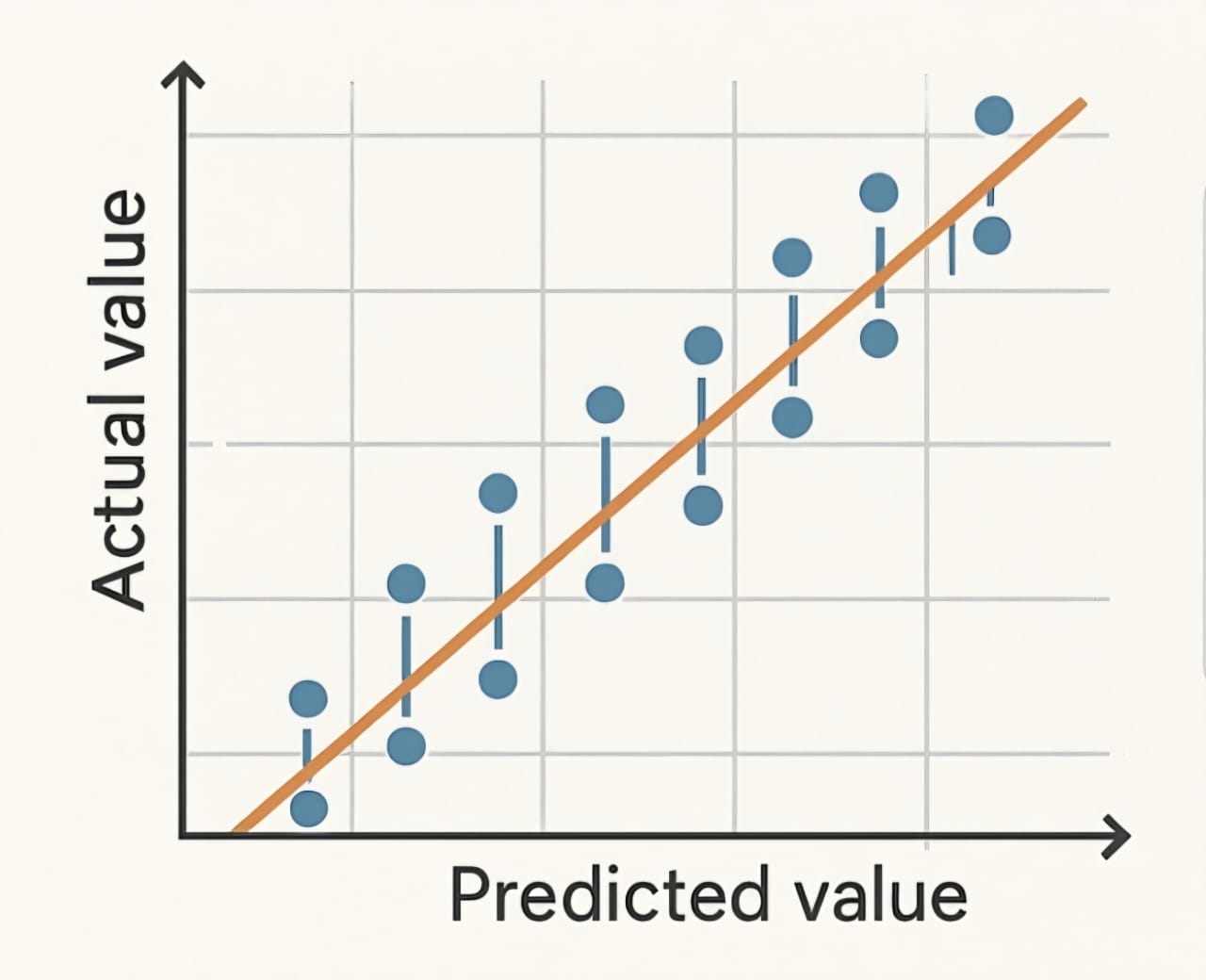
Graph showing actual vs predicted values with error visualization
  • Mean Absolute Error (MAE): "On average, how far off are our predictions?" Easy to interpret, same units as target
  • Root Mean Squared Error (RMSE): "How far off are we, with extra penalty for big mistakes?" Penalizes large errors more heavily
  • R-squared (R²): "How much of the variation can our model explain?" Scale from 0 (explains nothing) to 1 (explains everything)
Example: Predicting house prices with MAE of $15,000 means our average error is $15K, while R² of 0.85 means we explain 85% of price variation.

Cross-Validation

The Ultimate Reality Check

The Problem with Simple Train-Test Splits

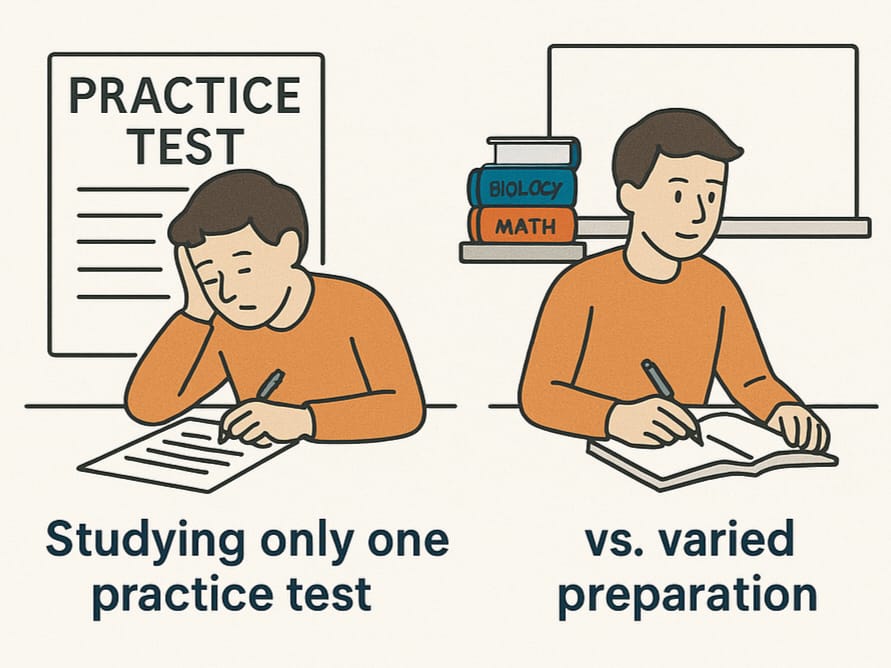
Student studying only one practice test vs varied preparation

Studying only one practice test vs. comprehensive preparation
The Issue: Imagine preparing for a final exam by only studying one practice test. You might do great on similar questions but struggle with anything different. A single train-test split might not represent the true difficulty of real-world problems.

K-Fold Cross-Validation: The Comprehensive Approach

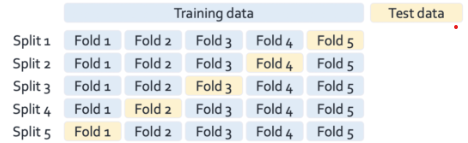
Visual representation of 5-fold cross-validation process

The Process (5-Fold Example)

  • Split data into 5 equal parts (folds)
  • Round 1: Train on folds 1,2,3,4 → Test on fold 5
  • Round 2: Train on folds 1,2,3,5 → Test on fold 4
  • Continue for all combinations
  • Average all test scores for final performance
Like taking multiple practice exams with different question sets!

K-Fold vs Leave-One-Out Cross-Validation

K-Fold CV

Process: Split data into k groups, test on each group once

Pros:
• Computationally efficient
• Good balance of bias and variance
• Works well for most datasets

Common choice: k = 5 or k = 10

Leave-One-Out CV

Process: Test on each individual data point, train on all others

Pros:
• Maximum use of data
• Very thorough testing
• Nearly unbiased estimate

Downside: Computationally expensive for large datasets

VS

Cross-Validation in Practice

Hyperparameter Tuning

Cross-validation helps us find the best settings (learning rate, tree depth, etc.) without overfitting to our test set.

Like adjusting your study schedule based on performance across multiple practice exams, not just one.

Example: Testing different values of k in k-nearest neighbors to find the optimal number of neighbors to consider.

Model Selection

When choosing between algorithms (linear regression vs decision trees vs neural networks), cross-validation gives reliable comparisons.

Like trying different study strategies across multiple subjects to see which works best overall.

Example: Comparing average cross-validation scores to choose between Random Forest (87% accuracy) vs SVM (84% accuracy).

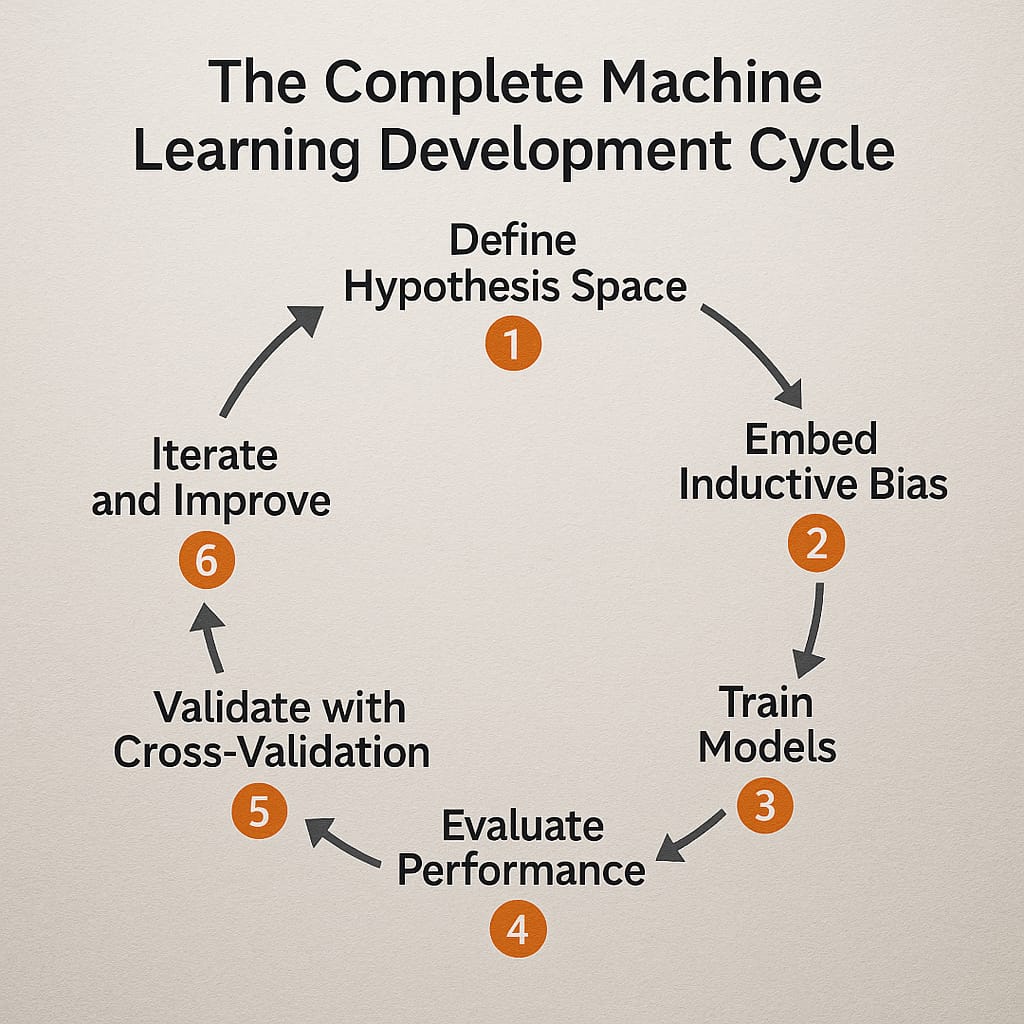
The Complete Machine Learning Development Cycle

Circular diagram showing the complete ML development process
The Iterative Process: 1) Define Hypothesis Space → 2) Embed Inductive Bias → 3) Train Models → 4) Evaluate Performance → 5) Validate with Cross-Validation → 6) Iterate and Improve. This cycle continues until we achieve reliable, generalizable models.

Key Takeaways for Successful Machine Learning

Remember these essential principles as you develop your machine learning expertise:

  • No Free Lunch: There's no universally best algorithm. Success comes from matching the right inductive bias to your specific problem
  • Think Like a Scientist: Always question your results. Use robust evaluation methods to ensure your model will work in the real world
  • Balance is Key: Navigate carefully between underfitting (too simple) and overfitting (too complex)
  • Human Expertise Matters: Your choices in hypothesis space, inductive bias, and evaluation fundamentally determine what your model can learn
Machine learning isn't purely automated magic. It's a collaborative dance between human insight and computational power!
Master these four concepts - Hypothesis Space, Inductive Bias, Evaluation, and Cross-Validation - and you'll have the foundation to tackle any ML challenge with confidence.
Slide 1 of 18