Artificial Intelligence
Application, Problems and Techniques
Dr. Dhaval U Patel • 2025
Part 1: Foundation
Why Intelligence Matters to Humans
Why We Are Called "Homo Sapiens"
Let's start with ourselves! We humans proudly call ourselves "Homo Sapiens" - and this name tells our entire story.
- Homo = Latin word meaning "human" or "man"
- Sapiens = Latin word meaning "wise" or "intelligent"
- Together: "Wise Human" - intelligence defines who we are!
Evolution
Think about how computers have evolved alongside human ambition:
- Early Computers (1940s-1960s): Only dealt with numerical calculations - fancy calculators!
- Modern Computers: Now involved in reasoning with knowledge, not just crunching numbers
- With AI: Computers transform from "useful tools" to "thinking partners"
Part 2: Definition
Artificial Intelligence?
The Great Challenge: Defining Intelligence
The Problem: This just gives examples, not a true definition!
Intelligence is the ability to acquire knowledge, adapt to new situations, solve problems, and achieve goals effectively in a changing environment.
The Solution: Computer scientists created four different approaches to defining AI...
The Classic 2×2 Framework
Computer scientists AI definitions:
🧠 THINKING
“[automation of] activities that we associate with human thinking, activities such as decision making, problem solving, learning…” (Bellman 1978)
🎯 ACTING
“The study of mental faculties through the use of computational models” (Charniak& McDertmott 1985)
👥 HUMANLY
“The study of how to make computers do things at which, at the moment, people are better” (Rich & Knight 1991)
⚖️ RATIONALLY
“The branch of computer science that is concerned with the automation of intelligent behavior” (Luger & Stubblefield 1993)
The Four Traditional Definitions
🧠👥 Thinking Humanly
Goal: Automate human thinking processes
Example: Decision-making, problem-solving, learning like humans
🎯👥 Acting Humanly
Goal: Make computers do things humans are better at
Example: Turing Test - can you tell if it's human or AI?
🧠⚖️ Thinking Rationally
Goal: Study mental processes through logical models
Example: Perfect logical reasoning and deliberation
🎯⚖️ Acting Rationally
Goal: Automate intelligent behavior rationally
Example: Always taking the "right" action for the goal
Why Three Definitions Don't Work
🧠👥 Thinking Humanly - The Problem:
- Humans can't explain their own thinking
- We don't want to copy human flaws (bias, emotions, irrationality)
🎯👥 Acting Humanly (Turing Test) - The Problem:
- Human behavior should be a milestone, not the goal
- We want AI to be better than humans, not just equal
🧠⚖️ Thinking Rationally - The Problem:
- Not all intelligence is logical (sometimes you need quick reflexes)
- Logic without purpose isn't intelligence
🎯⚖️ Acting Rationally
The Goal: Focus on taking the "right action" regardless of the internal process.
Key Advantages:
- Goal-oriented: Actions are in pursuit of something valuable
- Flexible: Can include both deliberative and reflexive actions
- Measurable: We can objectively evaluate if actions are "right"
- Practical: Focuses on outcomes, not internal processes
The Rational Agent - Modern AI Definition
Building on "Acting Rationally," we arrive at the Rational Agent View - the most widely accepted definition of AI today.
The Components:
- 🔍 Sensors: How the agent perceives the world
- 🎯 Effectors: How the agent acts upon the world
- 🧠 The AI Brain: The computational part that decides actions
- 🌍 Environment: The world the agent operates in
- 📊 Performance Measure: How we define "success"
Part 3: Current Reality
What Types of AI Exist Today?
The Three Levels of AI Intelligence
🎯 Narrow AI (Current Reality)
What We Have Today
- Performs ONE specific task very well
- Cannot go beyond its training
- Examples: Chess programs, facial recognition, Siri, ChatGPT
🧠 General AI (The Goal)
The Holy Grail
- Can perform ANY intellectual task like humans
- Thinks and learns like humans
- Currently doesn't exist!
Super AI: Beyond Human Intelligence
The final frontier - and the most controversial topic in AI!
- Current Status: Purely hypothetical - doesn't exist yet
- The Big Question: Would this be humanity's greatest achievement or greatest threat?
- Research Focus: How to ensure AI remains beneficial to humanity
Part 4: Applications
AI in the Real World
Why Do We Need AI? The Perfect Partnership
🖥️ Where Computers Excel
1. Numerical Computations:
- Computers can multiply 1.89254 × 8.29743 instantly
- Humans need minutes and make errors
- Perfect accuracy, lightning speed
2. Information Storage:
- Store virtually unlimited information
- Perfect recall, no forgetting
- Humans have limited memory capacity
3. Repetitive Operations:
- Never get bored or tired
- Consistent performance
- Humans make mistakes when bored
🧠 Where Humans Excel
Intelligent Tasks:
- Creative problem solving
- Understanding context and emotions
- Making intuitive leaps
- Learning from few examples
- Dealing with ambiguity
What AI Can Give Us:
- Solutions to complex real-world problems
- Virtual assistants (Siri, Alexa)
- Robots for dangerous environments
- New technologies and opportunities
Real-World Applications of AI
AI isn't just science fiction - it's already transforming our world in amazing ways:
- 🏥 Healthcare: Providing better and faster diagnosis than human doctors
- 🚗 Transportation: Self-driving cars and traffic optimization
- 💰 Finance: Chatbots resolve consumer queries and detect fraud
- 📱 Social Media: Analyzing trends and understanding user requirements
- 🛒 E-commerce: Recommendation systems (Netflix, Amazon)
- 🎮 Gaming: AI machines can play strategic games at superhuman levels
- 📚 Education: Personalized learning and automated grading
- 🔭 Astronomy: Helping us understand the birth and workings of the universe
Part 5: AI Working - AI problems
Understanding AI Problems by Complexity
AI tackles problems at different levels of complexity. Think of it like a skill pyramid:
• Recognizing people and objects
• Navigation and robot control
• Game playing
Skills needed: Perception, basic reasoning
• Engineering analysis and design
• Scientific analysis
• Theorem proving
Skills needed: Logical reasoning, strategic planning
• Medical diagnosis
• Financial analysis
• Complex engineering tasks
Skills needed: Deep expertise, pattern recognition
The Three Fundamental AI Techniques
Think of these as the three pillars that support all AI systems:
When there's no direct solution path, AI explores different possibilities systematically.
Example: Finding the best move in chess by exploring millions of possibilities
AI uses structured information about the world to solve complex problems.
Example: Medical AI uses knowledge about diseases, symptoms, and treatments
AI focuses on important features while ignoring irrelevant details.
Example: Recognizing a cat regardless of its color, size, or position
Key Insight: Knowledge is powerful but challenging - it's voluminous, poorly organized, constantly changing, and differs from raw data. AI techniques help us handle this complexity efficiently!
Part 6: Implementation
How We Build AI Systems
Production Systems: The Engine of AI
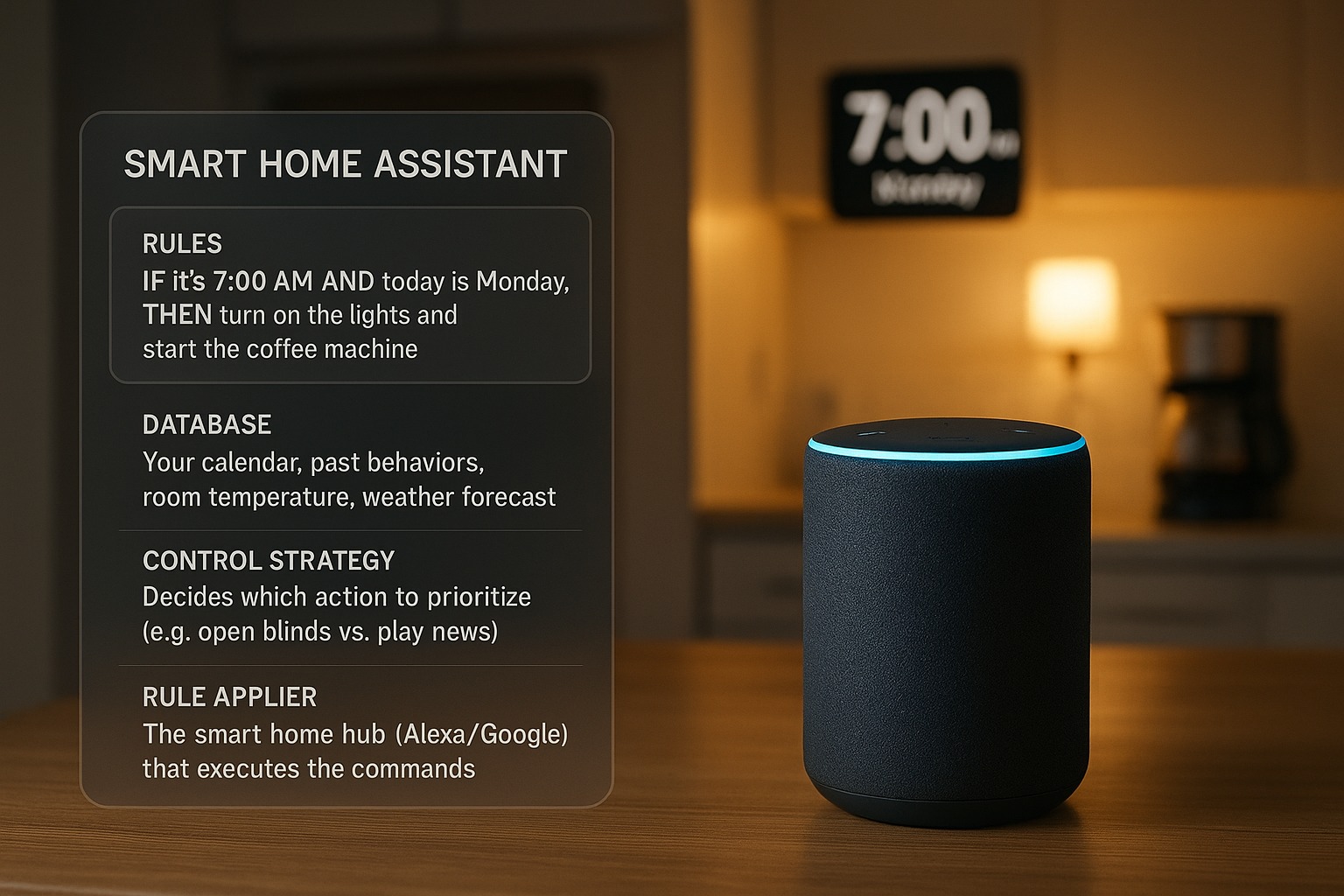
Production systems are like the "brain" of AI programs - they provide artificial intelligence through rules and logic.
The Four Components Explained:
- 📋 Rules (IF-THEN statements): Each rule has a condition - if the condition is met, the rule fires
- 🗄️ Database/Knowledge Base: Contains all the information relevant to the current problem
- 🎮 Control Strategy: Decides which rule to apply when multiple rules could fire simultaneously
- ⚙️ Rule Applier: The computational engine that actually executes the rules
Why Production Systems Work So Well
Production systems are popular in AI because they have four amazing characteristics:
Each rule uses clear IF-THEN structure. Every sentence is unique and easy to understand.
Benefit: Anyone can read and understand the logic!
Knowledge is coded in discrete, independent pieces. Like LEGO blocks!
Benefit: Easy to add, modify, or delete information without side effects.
Rules can be modified easily. Start with basic rules, then refine them for specific applications.
Benefit: Systems can evolve and improve over time!
Stores pure knowledge in human-readable language, separate from programming logic.
Benefit: Domain experts can contribute knowledge without programming!
The Bottom Line: Production systems make AI development more manageable, understandable, and collaborative!
Understanding Problem Characteristics
Before solving any AI problem, we need to analyze it carefully. It's like choosing the right tool for the right job!
The Seven Key Questions Every AI Engineer Asks:
- 🧩 Decomposability: Can we break this into smaller, independent sub-problems?
- ↩️ Reversibility: Can we undo solution steps if they prove unwise?
- 🔮 Predictability: Is the universe (problem environment) predictable?
- ✅ Solution Quality: Is a good solution absolute, or do we need to compare all options?
- 🎯 Solution Type: Is the solution a final state or a path to get there?
- 📖 Knowledge Role: How important is domain knowledge for solving this?
- 👥 Human Interaction: Does the task require interaction with people?
Summary: Our Journey Through AI
What We've Learned - Step by Step: